Introducing The Everyday Noticing Field Guide
A Noticing-to-Writing Approach for Joyful Writing in Grades 6–12
A simple approach to building stronger writers using the books you already have and the world around them
Coming May 22, 2026
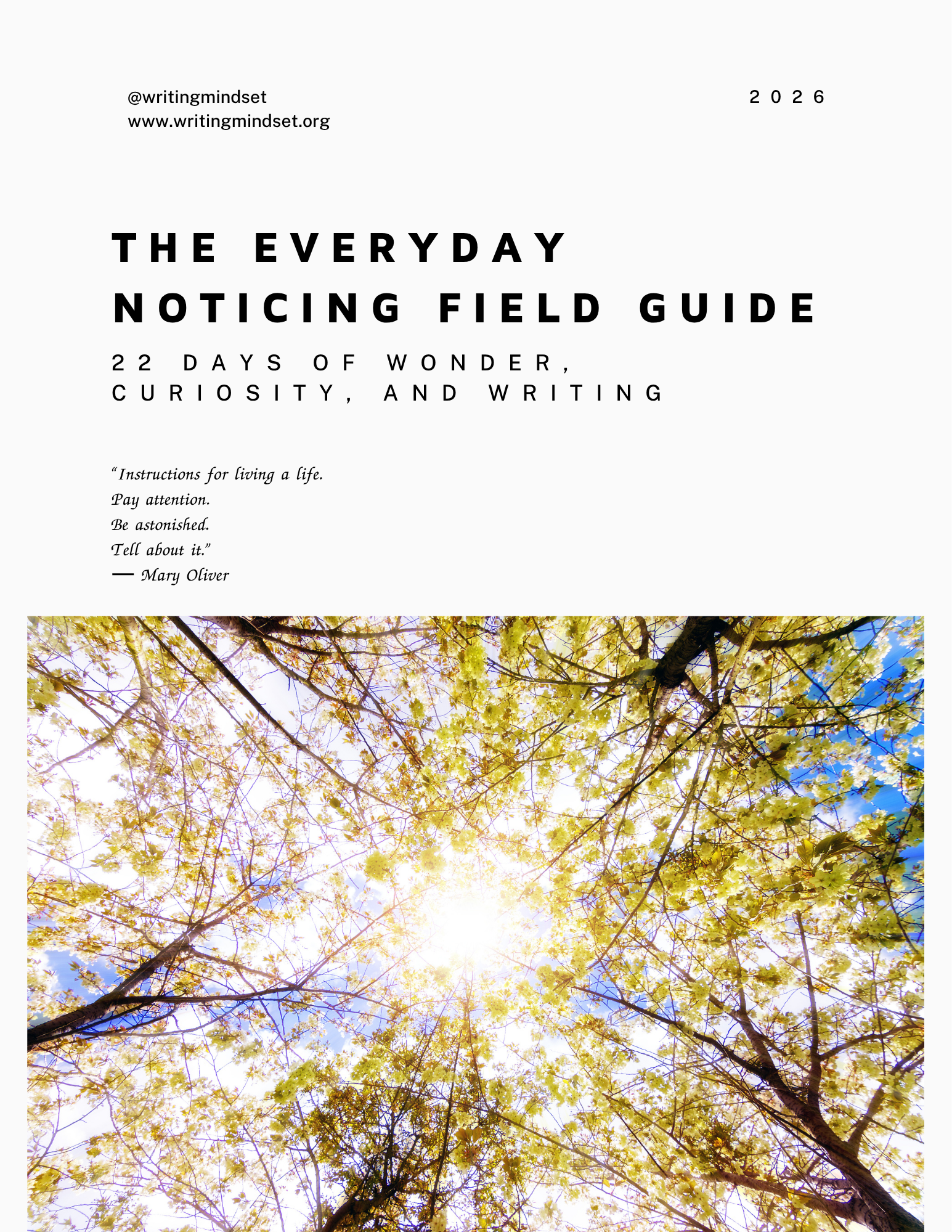
What happens when we slow down long enough to truly notice the world around us?
The Everyday Noticing Field Guide is a 22-day guided experience designed to help teachers, writers, and curious observers reconnect with attention, creativity, and meaningful reflection through everyday life.
Through short, approachable entries focused on ordinary things—clouds, doors, shadows, birds, trees, dust, light, grocery stores, insects, and more—you’ll practice seeing familiar spaces with fresh eyes.
Each day includes:
A short nonfiction “small truth”
Guided observation prompts
Quick sketching and notebook invitations
Writing progressions
Reflection and discussion ideas
Mini-lesson support for educators
Whether you’re preparing for the school year or looking for a personal creative reset, this guide invites you to notice more deeply and think more intentionally.
-
The guide begins with one simple idea: meaningful thinking starts with attention.
In a world built around speed, this practice helps readers pause long enough to observe small details, changing patterns, and moments often overlooked. Instead of rushing toward answers, learners begin with curiosity.
For teachers, this creates stronger descriptive writing and authentic classroom discussion.
For writers, it becomes a daily practice of mindfulness, reflection, and creative renewal. -
A cloud becomes a conversation about change.
A fly becomes a lesson in systems and perspective.
A shadow becomes evidence of movement, light, and time.The field guide helps readers discover that ordinary objects and moments can lead to deeper thinking, storytelling, science, memory, and meaning.
Students do not need extraordinary experiences to write well—they need practice noticing what is already around them.
-
Many students—and adults—struggle to begin writing because they believe they have “nothing to say.”
This guide changes the starting point.
Each activity moves naturally from:
noticing → sketching → thinking → writingWriters learn how collecting specific details creates stronger imagery, richer reflection, and more original ideas. The process feels accessible because the writing grows directly from real observation.
-
Noticing helps us feel connected:
to place
to memory
to nature
to other people
and to ourselves
The guide encourages readers to ask thoughtful questions, consider different perspectives, and recognize meaning in small moments. Over time, observation becomes more than a writing strategy—it becomes a way of moving through the world with curiosity and care.


Designed for Teachers
This guide is a simple, ready-to-use way to get students writing naturally—without heavy setup, over-explaining, or forcing a prompt that doesn’t connect.
Instead of starting with abstract writing assignments, students begin with what they can actually see, touch, and notice in their everyday world. Observation becomes the entry point, and writing grows directly from that experience.
Teachers can use the activities as:
quick daily warm-ups that build writing fluency
low-prep notebook routines that encourage consistency
mini-lessons that naturally move from noticing → writing
discussion starters that support academic language and thinking
flexible activities that fit into science, ELA, or interdisciplinary blocks
The result is writing that feels more accessible, more grounded, and more connected to real observation—so students start writing because they have something they genuinely noticed, not because they were told to “write about anything.”
Inside the Guide
You’ll explore topics like:
Clouds
Shadows
Birds
Trees
Water
Trash
Stairs
Dust
Windows
Insects
Light
Leaves
Places You Return To
and more
Every page is designed to help readers move beyond surface-level observation into deeper reflection, curiosity, and creative thinking.