

It All Starts With The Book Talk!
Reading and writing are all too often cyclical. Everyone knows good reading fuels good writing and vice versa. As a middle school teacher, I really wish that I was able to teach reading and writing separately or even give them their own block of time, but I do also love the impossible harmony that is being a reading AND writing teacher. This post will explain how I start my week with students, and how I often will start each class. I always start each hour the first day of the week with a book talk about a middle grade or young adult novel or nonfiction book. It kicks off my mentor text work with kids, and it gets them excited about a book they may or may not have heard about before. This post goes into detail to explain why the simple act of talking about books in a way that makes kids want to read them is one of the most important things we can do as teachers each day.

Build Classroom Community with Where I'm From Poems and I Am Poems
I always end the first six weeks of school with narrative poetry. 1.) It is a mindset thing. I want to show the kids who don’t think they can write poetry that they indeed can write poetry. 2.) It is an excellent way to get to know students better. We may think we know each other after six weeks, but in reality, we have spent a lot of that time on testing and expectations. it is powerful to know our students and let our students know who we are as people. Cue Where I’m From Poems and I Am Poems. I use this form of poetry from George Ella Lyon each year to help build community and access important identity work. This post includes all of the assignment materials and my step-by-step process including mentor texts and a read-aloud.

A Complete Guide on How to Do a Class Research Project Focused on Activism
Arthur O’Shaughnessy in his 1874 poem “Ode” wrote: “Yet we are the movers and shakers/Of the world forever, it seems.” I love the term “mover and shaker” because it reminds me of dancing, but what it really lends is to people who make an impact on the world. It is no secret that one of my favorite units to teach is research. I love the choice, the process, and the hard work it takes to produce the product. I also love seeing middle schoolers wrap their brains around the formatting of this project (MLA), and how they get excited about solving problems. One of my favorite things, after all, is to solve problems.
The MLA Research Paper unit I do each winter going into spring focuses on activism. Students identify a problem in their school, community, or world and then research that problem, Inevitably, they see causes, effects, and hypothesize solutions as well. This post will walk you through some mentor texts and resources, strategies, and pacing of the overall unit.

Using Mentor Texts to Teach Similes in Writing
Similes and metaphors might be my favorite figurative language skills to teach because once students notice what they are, they find them everywhere in fiction literature. Similes make everything better. At first glance, students keep reading over them, but the understanding of similes and metaphors unlocks another layer of reading. It is a layer that is deeper and makes readers really think. Figurative language skills matter because they help build critical readers. When building sentence fluency, these skills create stronger readers that add sentence variety and fluency to their writing skills. While you can catch similes in almost any work of fiction these days, I like the books featured in this post for the deliberate instruction of simile usage in literature. This post will outline three books and examples of similes, and it will also show you how I help young writers transfer these skills to their own writing through the mentor text process.
Easy as pie.

Everything You Need to Do an Argumentative Essay Project
The idea of constantly evolving and changing how we shape lessons is one of the many reasons I am still a teacher. I have changed how I teach argumentative writing from shorter on-demand projects to longer multi-genre projects. We have done paragraphs. We have done essays. Normally for this particular project, I connect the topic choices to the novel we just got done reading. However, I always have to remind myself to be inclusive and responsive to the class that I am teaching. Here is the bottom line: My class just wasn’t into Roll of Thunder, Hear My Cry by Mildred Taylor. After trying to get a grasp on history, having great class discussions, and talking about plot elements in the text, my class was simply ready to move on. This feeling of wanting to press on along with the feelings of wanting to do more cycles of argumentative writing gave way to the approach I took for this project. I have combined many aspects of how I teach argumentative writing over the years. You will see essay packets, example essays and mentor texts, and the various ways I try to grade throughout the process to make sure I stay above the paper line. However, this post will also outline the intention of showing our students that learning this process can be ultimately tied to the debate process, and the issues we are talking about genuinely have an impact on our lives now. With a class that seemed a little out of touch, nothing can be a better tool to put them back in touch than an argumentative essay.

5 Tips and Tricks for Teaching the Argumentative Essay
When that beautiful time of year rolls around to teach the argumentative essay to your middle school students, you might find yourself crinkling your nose and thinking, “Oh boy, let’s just get through this.”
I don’t blame you!
Teaching the argumentative essay is no easy feat. You aren’t just teaching students the flow and structure of writing, but you are also teaching them how to research, evaluate evidence, make a claim, argue, convince, and write in a formal style. Many of these skills might be new to your students, so it is important to go slow, keep it simple, and make it very clear.
Today we are going to be looking at 5 tips and tricks to help you teach the argumentative essay to your students in a fun, clear, and simple way!
Mentor Texts are Golden
Structure is Everything
Research is Key
The Little Details Matter
Checklists are a Must

Using Mentor Texts to Teach Onomatopoeias!
For the week back from winter break, I love doing figurative language review, especially with onomatopoeias! If you have been following the mentor text routine on the blog, I always start with a book talk. For onomatopoeias, I love The Wild Robot by Peter Brown because there are so many great examples, and the mentor text example sentences involve the island animals as well. Kids love sounds. Kids love animals. Not only does this lesson provide an easy frame for students to follow, the book naturally pulls kids in with interest and content. This post outlines a quick lesson you can do with your students to use mentor texts and have some fun teaching onomatopoeias.

The Best of Writing Mindset in 2019
What a year this has been! 2019 is coming to a close tomorrow with New Year’s Eve, and I wanted to take a moment to say thank you for sharing this blog space with me throughout the past year. In January 2017, I started Writing Mindset as a way to reflect on teaching. Now, I focus on the ability to not only reflect on teaching, but to also constantly share ideas and learn from others. This blog has been and continues to become a passion project that is an outlet for my learning through teaching. It is also a space that is teaching me so many things. I am always in the role of a student when I am working on Writing Mindset. What I love most about education is trying new ideas and learning new strategies as ways to give and receive information. I am a Questioner, but more so, I am a person who loves to reflect on what went well and the things that did not go so well in my classroom and in life. 2019 was a rollercoaster of reflection. I was awarded the Michigan Council of Teachers of English Middle School Teacher of the Year, I pushed myself outside of my comfort zone by presenting at conferences, and with 48 total blog posts in 2019, I wrote more than any other year so far on the blog. I lend that to being wildly passionate about mentor texts, but I also feel like I am getting closer to why this blog exists in the first place. Writing Mindset is a way to use writing to access mindfulness, mindset, and overall wellness. I can see 2020 becoming a year when I focus more on the whole teacher. This includes the mental, physical, emotional, and intellectual health of anybody in education. Our wellness is an access point to more complex issues in education. As I said in the winter break post recently, our health is their health. Too many of us are unhappy, and too many of us are unhealthy. I can’t wait to explore some of the ways teachers can continue to be happier and healthier in 2020.
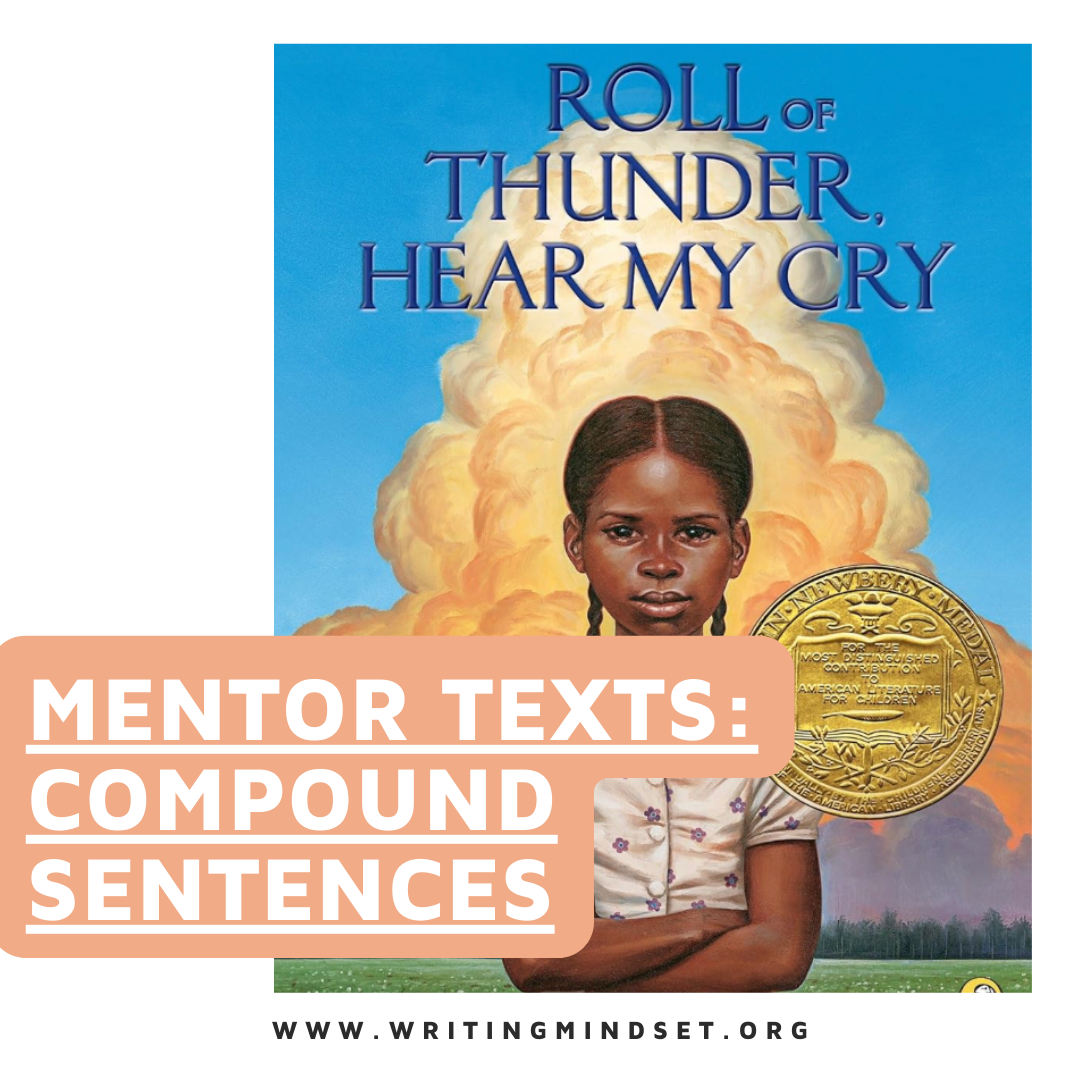
Using Mentor Texts to Teach Compound Sentences
Compound sentences are all about bringing ideas together or showing how those ideas relate to one another. There is a real opportunity when we start talking about combining sentences together to help build the classroom community and share how our writing looks in different situations. The very nature of conjunctions suggests jointness. It is during these mentor text lessons where I will increase the level of movement and partner work to show how we can generate ideas together. When completing the mentor text routine, I look at how I can book talk mentor text books so students want to read them, and I use the whole class novels that we study during this marking period to show example sentences. Last year, I covered the conjunctions “and” and “but.” This year, I am also adding the conjunction “so” to tie in some cause and effect lessons. This post will outline the mentor text slides and activities used for each sequence of lessons for compound sentences with the conjunctions “and,” “but,” and “so.”
Highlights of each conjunction:
But-This conjunction is fun to say to middle schoolers over and over, and it shows opposites.
And-This conjunction connects ideas and shows addition.
So-This conjunction shows cause and effect, and the ideas here can transfer over to other cause and effect work in class.

Using Mentor Texts to Teach Adjectives and Introduce Snapshots
These two weeks focus on adding adjectives and snapshots in narrative writing using the mentor texts Out of My Mind by Sharon Draper and A Wrinkle in Time by Madeleine L'Engle. Both of these lessons build on each other as I first teach using adjectives in writing, and then we get some experience making snapshots in regards to characters and setting. A snapshot is a moment in writing that provides detail in terms of character or setting. The text The Reviser’s Toolbox by Barry Lane was the first text that introduced the idea of snapshots to me, and this text remains the go-to standard for items to teach in terms of narrative, personal narrative, and memoir writing. Students often receive practice in regards to describing themselves or character, but sometimes struggle with describing a setting or character interaction. Teaching them how to add detail in narrative writing sets the stage for teaching elaboration when it comes to argumentative and informational writing in our upcoming units.

Using Mentor Texts to Teach Irregular Verbs
The mentor texts for these two weeks, Ghost Boys by Jewell Parker Rhodes and The War That Saved My Life by Kimberly Brubaker Bradley, are similar in the sense that they are amazing examples of kids working through problems. Both books are easy to sell during the book talk because kids love books where students are handling conflict. I love teaching irregular verbs over the course of two weeks because the first week we learn what irregular verbs are and then do some practicing with examples. In the second week, we combine standard past tense verbs with an -ed ending, AND we also use irregular verbs in our sentences. We are still building on our work with action verbs/verbs of being and helping verbs from previous weeks.

Using Mentor Texts to Teach Helping and Linking Verbs
The Crossover by Kwame Alexander might be one of my all-time favorite mentor texts. It could be because kids love the novel-in-verse format of this book, or the basketball theme, or the fact that they want to know what happens each quarter. This is an easy book to book talk because it just grabs kids. I love using this book to show helping and linking verbs in the present tense. This continues from the work the previous week where students identified action verbs and verbs of being. This lesson speaks to the easy conversational tone that we all have with each other on a daily basis. Kwame Alexander sounds like me. He sounds like you. This directly links to the ability to make grammar accessible because it is something we already know, we just have to know what to call the writer move when we make it.

Using Mentor Texts to Teach Verbs of Action and Being
Fish in a Tree by Lynda Mullaly Hunt is our all-sixth grade read. Our district gave all fifth graders this book to read over the summertime, so they have a chance to have a common, shared conversation about a single text when they enter middle school. While not all students take part in the rising class read, all students are given books. The best way to promote this text is through a book talk. Often, I hear students say “I didn’t read this book over the summer,” and then they choose to pick it up after they hear it book talked. We can never forget the power of a book recommendation to our students. The goal for this small mentor text mini-lesson will be to show students the difference between verbs of action and verbs of being.

Using Mentor Texts to Teach Simple Sentences
One of my big mentor text reflections from last year was that I felt like I didn’t spend enough time on the basic parts of the sentence. Things like subject, predicate, verbs, and adjectives. These are the things that middle school teachers are always teaching and re-teaching, but I really wanted to frontload these skills at the beginning of the year. There are so many variations in the English language, so I really want to encourage my sixth-graders to have a strong grasp of the simple sentence before moving forward. Even in my advanced sections where students have reading levels well into the highschool range, they were identified as struggling on identifying the subjects of sentences.

Start a Mentor Text Routine in 3 Easy Steps
Sometimes the hardest part is knowing where to start. I want to start writing individual posts each week, so that people can follow along with my mentor text routine. It can be daunting looking at all my materials for the first time and thinking:
“How do I find time to read all of these books?”
“How do I teach kids to read like writers?”
“Where do I put this into my curriculum or pacing guide?”
“Can I really teach grammar with books on my shelves?”
The answers to these questions aren’t always easy, but they are possible. We have to make time to show our kids that books have the power to unlock the world of writing in front of them. We have to dedicate space in our own lives for reading because it is one of the greatest forms of self-care. We have to reconfigure our pacing guides to use these resources because we have to prioritize what matters. Figuring out what matters to me as a teacher has always been the struggle. I know without hesitation that the use of mentor texts has changed the way I do business in my classroom. Last year was a road trip of trials and errors, but those experiences and that time spent researching mentor texts was so worth it. Now, I also wanted to share what I am doing to help lighten the load on others.

Using Mentor Texts to Analyze How Kids See Schools and Teachers
It might be an interesting experiment to pose some of these questions to your students this fall:
“How do you see your teachers?”
“What do you like or dislike about school?”
“What would you change about how school is setup?”
I bet we would get a ton of answers that would spark debate and some good-natured arguments. Another interesting take on these questions is to look at how school and teachers are represented in popular middle-grade and young adult texts. I originally started working on this post as a way to access narrative writing by looking at how authors portray kids’ thinking about schools and teachers. However, then I got to thinking about the bigger discussion we as teachers need to be having with our students. I am going to use this in my classroom as a way for students to talk about their feelings toward school and teachers, and then connect how they feel to what they want in their own experiences in education moving forward. I want to keep in mind that these middle-grade and young adult texts are written by adults for young people, but some of their descriptions about school and teachers are surprisingly accurate. It would be interesting to cut up and put some of these passages in front of students to hear what they have to say.

Middle-Grade Narrative Writing: Using Mentor Texts to Describe Characters
In my other post, “Middle-Grade Narrative Writing: Using Mentor Texts to Describe Setting (Snapshots)” I explained how a teacher could use examples or passages in mentor texts to help their young writers add details, description, and imagery to their narrative writing. This ability to “see” or visualize the imagery is called making a snapshot. Snapshots were first introduced to me by the way of Barry Lane’s The Reviser’s Toolbox. Characters really have five areas of focus when it comes to description: thoughts, feelings, actions, appearance, and speech. All of these areas can afford opportunities for students to learn how to do snapshots.
In review, a snapshot is a moment in narrative writing when you stop to describe a person or place in detail. There are many different writing moves to do this technique; however, the gist is the same: stop to inform your reader what the imagery is in your writing so they can become part of the reading experience with you. When you are designing a lesson on snapshots in either setting or character, I first like to start with adjectives and describing things my students know a lot about. Then, we can move on to the more abstract ideas of the imagination. The bridge between simple adjective description and more sophisticated writing resides in the use of mentor texts. I also like to practice all together in a whole group format using pictures. I love Nearpod for this type of practice because students can share adjective word ideas, and you can track whole group class participation. It is also pretty cool whole group collaborative writing. In the post, I will outline four different strategies for helping you to introduce snapshots for character description to your students with a variety of middle-grade mentor texts. I use mentor texts in my classroom to teach grammar, provide book talks to my students, and in writing instruction. Students then mimic the style of published authors and use their writing as a guide to help set up their own writing.

Middle-Grade Narrative Writing: Using Mentor Texts to Describe Setting (Snapshots)
I always start and end the year with narrative writing in some form. While I often focus on things like voice and ideas with this genre of writing, it really is all in the details when it comes to helping the reader see what you are talking about on the page. This ability to “see” or visualize the imagery is called making a snapshot. Snapshots were first introduced to me by the way of Barry Lane’s The Reviser’s Toolbox. I first got a hold of this text working closing with an elementary school teacher writing friend who explained to me, “You know what we do isn’t really all that different.” I have been changed ever since.

What I Would Change About My Mentor Text Routines at the End of the Year
Sometimes we try something in our classrooms and we immediately toss it in the recycle bin as a really good try, and sometimes we find something that changes how we do business. Using middle-grade and young adult books as mentor texts in my classroom has completely changed how I approach grammar instruction and promoting literature in my room. I love mentor texts. I wish you could hear my screaming about mentor texts. I talk about them now all the time. The power for students to see their own writing on the page in the same manner as a published author coupled with the use of book talks in my room as a way to recommend books to others through my voice and theirs has altered the mindset about reading in my room. Reading has always mattered. Now, it it just makes sense in terms of writing. While mentor texts themselves are not a new phenomenon, the incorporation of deliberate (and fun) grammar instruction is a new addition to my classroom.

How to Choose and Break Down a Mentor Text
I am constantly reading books. This wasn’t always the case, and largely, I think I have to attribute my reintroduction to reading all the time to my mentor text work. I am constantly on the mission to find books to recommend to students and use in the classroom with my students for our “write like an author” study. As teachers we are bombarded with an onslaught of a million decisions, pounds of papers to grade, and work that is largely impossible to master. It’s exhausting.
But, it is also exhilarating.